A lot of people are talking about artificial intelligence these days. Some see it as a powerful tool for good. Others worry about its risks. In humanitarian work, both things are true at the same time.
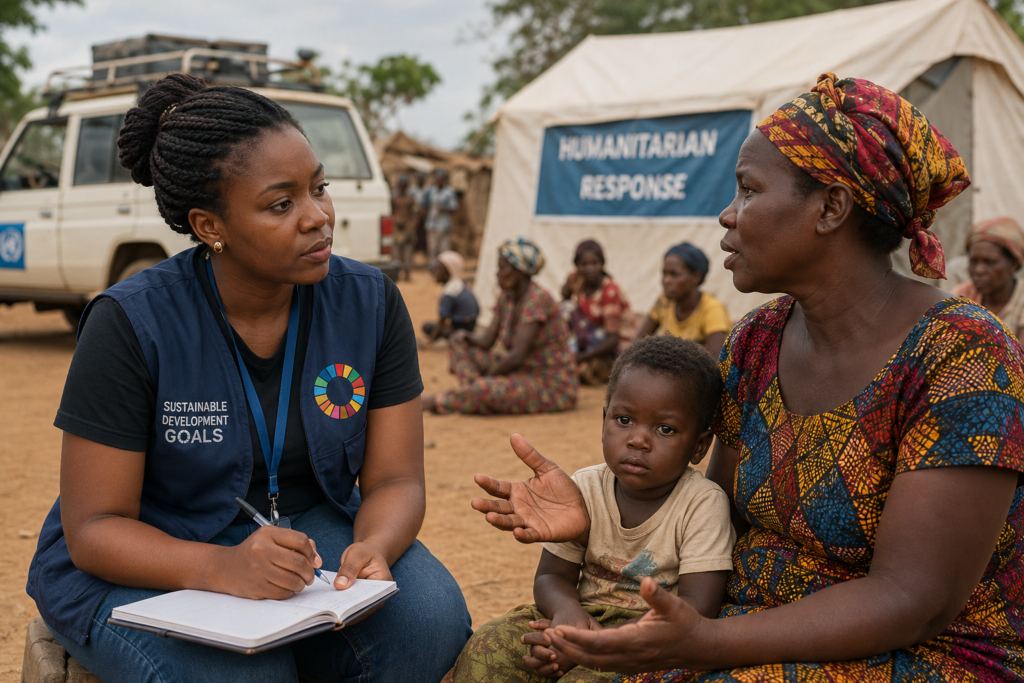
I work with an organisation that focuses on the Sustainable Development Goals. We care about feeding the hungry, keeping people healthy, and building peaceful societies. To do that well, we need good information. We need to know what is really happening on the ground, so we can decide where to send help and how to spend limited resources.
But artificial intelligence is changing how information is made and shared. And that change is happening faster than most of us realise.
The old balance between speed and checking
In the past, humanitarian information worked on a simple balance. You could get information quickly, or you could get information that had been carefully checked. Usually you could not have both at the same time. A field report might take days to arrive, but you knew who wrote it and you could trust their judgment.
That balance is breaking down. Generative AI can now produce convincing reports, summaries, and analyses in seconds. The problem is not that AI is always wrong. The problem is that we cannot easily tell which parts are reliable and which parts are made up. A single AI tool can generate thousands of different versions of a story, each one slightly different. No human team can fact check all of that in real time.
What keeps me awake at night
I have been researching how AI affects trust in information, especially in places like Ghana where I am from. During our last election, a video of a vice presidential candidate appeared online. His campaign immediately said the video was fake, made by AI. Later, independent experts proved the video was real. But the damage was already done. People were confused. They did not know what to believe.
This is what scares me most. It is not just that AI can create fake content. It is that the existence of AI gives people an excuse to call anything they do not like fake. When that happens, the whole idea of reliable information starts to fall apart.
For humanitarian organisations, this is dangerous. If we cannot trust what we see and hear, how do we decide where to send food or medicine? How do we know when a disease outbreak is real? How do we protect people from violence if we are never sure what is true?
Why this matters for the SDGs
The Sustainable Development Goals are built on the assumption that we can measure progress honestly and act on good evidence. AI risks undermining that assumption in several ways.
SDG 2 (Zero Hunger). If a needs assessment for food aid is partly generated by AI with hidden errors, we might send supplies to the wrong villages while hungry families go without help.
SDG 3 (Good Health). If an alert about a new disease outbreak cannot be verified quickly, we might either miss a real emergency or waste resources responding to a false alarm.
SDG 16 (Peace and Justice). Deepfakes and synthetic media can be used to spread lies during elections or to incite violence between communities. Once trust breaks down, it is very hard to rebuild.
The people who designed the SDGs did not imagine a world where anyone could generate realistic fake videos from their phone. We have to catch up.
What we can actually do
I have read a lot of proposals for dealing with AI risks. Many of them focus on technical fixes, like watermarking AI content or building better detection tools. These things help, but they are not enough. In humanitarian settings, information moves through informal channels, like WhatsApp messages, radio broadcasts, and word of mouth. You cannot put a watermark on a conversation.
Instead, I believe we need to strengthen our own systems. We need to become more resilient, not just try to control the technology.
Five practical steps for SDG focused organisations
1. Be honest about what you know. Label information clearly: verified, unverified, or AI assisted. Do this inside your own systems before you worry about telling the public.
2. Build verification into your decision process. For big decisions, like opening a new programme or moving supplies across a border, require at least two independent sources. Slow down when the stakes are high.
3. Invest in local people. The best fact checkers are often community members who know the context and can spot when something does not feel right. Support them.
4. Train your staff. Many humanitarian workers have never been taught how AI works or how it can mislead them. A few hours of training can make a huge difference.
5. Never let AI make decisions on its own. Always keep a human in the loop. A machine can suggest. A human should approve.
A final thought
Artificial intelligence is not going away. It will only get more powerful and more common. That does not have to be a bad thing. AI can help us write faster, analyse data more thoroughly, and reach more people with our messages. But we have to be smart about how we use it.
The goal is not to block AI. The goal is to make sure that our decisions, especially the ones that affect people's lives, remain reliable. We need systems that can handle uncertainty without falling apart. We need teams that know how to question information, even when it looks perfect.
If we can do that, then AI becomes a tool for good. If we cannot, we risk building a humanitarian response on a foundation of sand.
Princess Besiwah Forson is an independent researcher focused on AI governance and media integrity. She works with an SDG focused organisation and has written extensively about public trust, misinformation, and information resilience in West Africa.